2(12.09)
2(12.09)
1(12.09)
I stumbled across a wonderful exhibit over the Thanksgiving weekend. I was on my way to the Hirshorn and decided to stop by the National Gallery of Art, East Building. The Meyerhoff Collection of Modern and Contemporary Art is not only an important collection, but the organization of the show is unique: “Rather than being divided by artist, movement, or decade, the works in the exhibition are arranged according to a different logic. Each of the ten categories explores one principal visual theme or material device of 20th-century art, as demonstrated and continuously reconfigured by the artists in the Meyerhoff collection.” The themes are Scrape, Concentricity, Line, Gesture, Art on Art, Drip, Stripe to Zip, Figure or Ground, Monochrome and Picture the Frame. This provided deeper understanding for my young sons allowing me to explain less and look more. I hope to visit again before it ends.
I also appreciate the idea of thematic reference rather than categorical. I would add three more: text, transfer and appropriation. I would like to see high school art contests/exhibitions pursue this route and do away with outdated discipline-oriented categories that have limited relevance to the art making of contemporary artists and art students.
I enjoyed the Arshile Gorky Retrospective at the Philadelphia Museum of Art last weekend. It was good to revisit his work in my current state of mind. I found his use of crayon noteworthy.

d(9.09)
c(9.09)
b(9.09)
a(9.09)
6(8.09)
5(8.09)
4(8.09)
3(8.09)
2(8.09)
1(8.09)
Film clip from the presentation: Waiting for God, Oh: Exploring (Questioning) the Hegemony of the Artifact in Art Education. Presented at the 2009 Pennsylvania Art Educators Conference by Ian Williams and David Miller.
1(9.09)
2(9.09)
3(9.09)
4(9.09)
5(9.09)
6(9.09)
7(9.09)
8(9.09)
9(9.09)
10(9.09)
11(9.09)
12(9.09)
13(9.09)
14(9.09)
15(9.09)
16(9.09)
17(9.09)
18(9.09)
19(9.09)
20(9.09)
21(9.09)
22(9.09)
23(9.09)
35(9.09)
34(9.09)
32(9.09)
31(9.09)
30(9.09)
28(9.09)
26(9.09)
25(9.09)
24(9.09)
I saw this exhibit a few weeks ago at the Delaware Art Museum. It is a small, but worthwhile show. I wish there had been a book to accompany it. Heather Campbell Coyle, the curator has created a blog about the exhibition. I discovered this from Ed Sozanski’s review in the Philadelphia Inquirer.
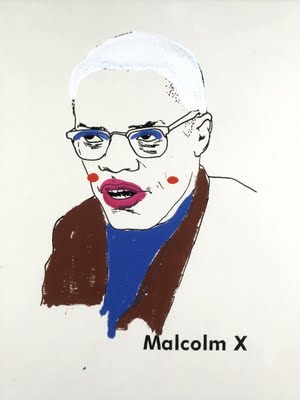
Glenn Ligon: Malcom X v.1#1
I just read this in Gerhard Richter: Overpainted Photographs. It is from an essay by Siri Hustvedt titled Truth and Rightness. I liked it.
For me, a work of art must be an enigma. It must push me into a position of unknowing or else I find myself bored by my own comprehension. I don’t write about art to explain it, but to explore what has happened between me and the image, both emotionally and intellectually. The act of looking, after all, always takes place in the first person. I see the object, but the very act of seeing it breaches the divide between me and it. At that moment aren’t subject and object bound together in a unified loop of perception? (p. 73).
I saw this in the current NAE News and liked it.
Fostering Community:
Cultivating K-12 Public Visual Arts Education in our American Democracy
The arts serve a range of public purposes, and therefore are of benefit and concern to all Americans (The American Assembly, 1999). They help to shape what it means to be an American – connecting the nation’s identity to the reality of American pluralism, and in so doing advance democratic values both nationally and globally. The arts contribute to the quality of life and economic growth – enabling America to establish successful communities while increasing the nation’s prosperity. They help establish and maintain a well-informed and responsive citizenry – promoting deeper understandings about our diverse society by developing competencies both in school and at work, and by promoting the freedom to inquire in pursuit of the open exchange of ideas and values. And most importantly, [we] believe, the arts enhance the life of the individual by contributing to one’s potential and spirit.
Fostering Community in Civic Dialogue
The arts present a powerful force for shaping both the ethics and soul of a nation’s citizenry that can “define reality, shape the times, and give meaning to history” (Hunter, 1991, p. 225). The potential of the visual arts to make images indelible; to express challenging ideas through allegories, comparisons, and symbols; and to respond beyond the limits of verbal communication make it a powerful force for informing civic experiences (Bacon, Yuen, & Korza, 1999).
Shauck, R.B. (October 2009). The arts and public priorities. NAEA News, 51(5), 1-2.
 DavidTMiller Art